Article Forge Alternatives Pricing Guide: What Automated Content Really Costs
AI content tools look cheap until you count the credits you actually burn. A $19 plan can vanish in a week once bulk generation and revisions start. Picking the wrong pricing model wastes money and stalls your publishing schedule.
This guide breaks down what automated content really costs, from hidden fees to credit rollover. You will see Autoblogging.ai's monthly and annual plans side by side, understand how credits and the human proofreader work, and decide whether the price fits your blog or agency.
What Is Autoblogging.ai?
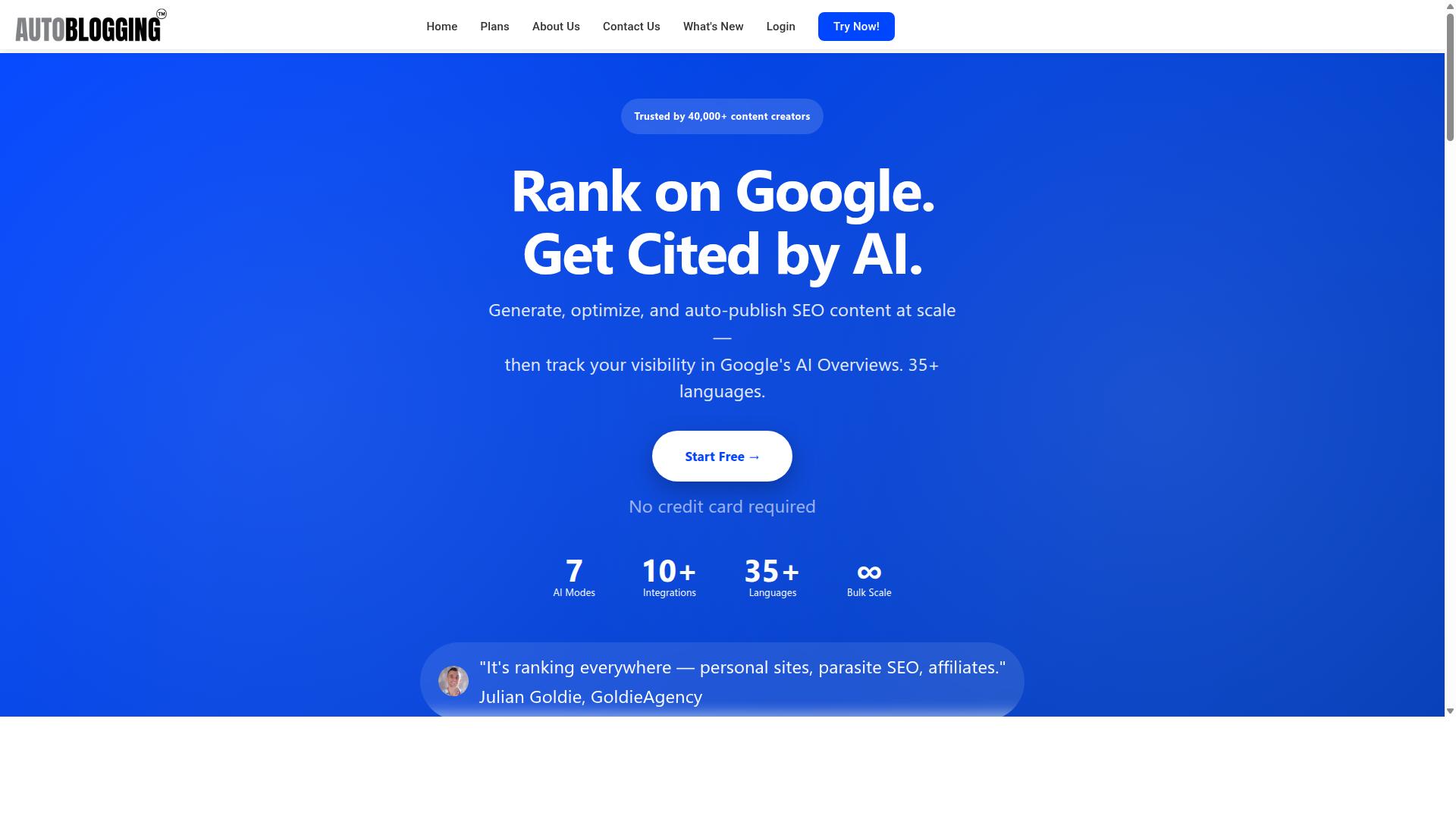
Autoblogging.ai is an AI-powered content generation platform that transforms keywords into fully-formed articles, designed for bloggers, marketers, and agencies who need to scale content production without sacrificing quality.
It is a SaaS tool for automated content creation, built around a straightforward purpose: turning a simple keyword into an SEO-friendly article using AI. Instead of staring at a blank editor, users start with a machine-generated draft and shape it from there.
The platform is a product of Digimetriq.com and was founded in 2022. Its stated mission is to help bloggers, website owners, and agencies save time and improve their online presence through cutting-edge technology.
That mission shapes how the tool positions itself within the wider market of AI writing tools. Autoblogging.ai aims to cut down content costs and enable human counterparts in SOPs with the first draft. Digimetriq, the company behind it, aims to replace human counterparts entirely.
The target audience is fairly broad within the content space. Core users include:
- Bloggers publishing on a regular schedule
- Website owners who need steady SEO content
- SEO professionals managing multiple client sites
- Agencies handling bulk generation for several projects at once
For anyone comparing Article Forge alternatives, this context matters. Understanding what Autoblogging.ai is, and who it was built for, sets the stage for evaluating how its pricing and output fit into a real content workflow.
What Automated Content Really Costs: The Real Pricing Math
When evaluating automated content tools, the sticker price is just the beginning. The true cost involves understanding credit systems, output limits, and the hidden expenses that can inflate your monthly bill.
Most AI writing tools advertise a headline number, whether that is a low monthly subscription or a per-article rate. What that number actually buys varies enormously from one platform to the next. Two tools can charge the same amount and deliver wildly different volumes of usable content.
There are three dominant pricing models in this space. Each one shifts the risk in a different direction, and each one rewards a different type of user.
- Subscription plans: A flat monthly or annual fee, often with a word or credit cap attached. Predictable, but you pay whether you generate ten articles or a thousand.
- Pay-per-article: You pay for each piece of content produced. Simple to understand, but costs climb quickly at volume.
- Credit-based systems: Credits are consumed per article, per word, or per generation mode. Flexible, but the math takes effort to track.
Several factors determine what you actually pay per usable article. Word count limits matter because a plan that caps output at 800 words forces you to run the tool twice for a long-form piece. API access often sits behind a higher tier, which matters if you want to connect content generation to your own workflow.
Bulk generation is another variable. Some tools charge the same rate whether you produce one article or fifty. Others apply separate pricing for volume, or restrict bulk runs to premium plans. Annual billing usually lowers the effective monthly rate, but it locks in your spend before you know whether the output quality holds up.
The practical takeaway is to calculate cost per usable article, not cost per generation. That means factoring in editing time, fact-checking, and any add-on tools you need to make the output publishable. The next two sections break down where cheap tools hide their real costs and how credit systems work in practice.
Hidden Costs of Cheap AI Content Tools
Many budget AI writing tools lure users with low monthly fees, but the hidden costs emerge in the form of poor output quality, required heavy editing, and additional expenses for plagiarism checks or human proofreading.
The first hidden cost is time. A tool that produces generic, repetitive, or factually shaky drafts can take longer to fix than to write from scratch. That editing burden rarely appears in a cost comparison, yet it is often the largest line item.
Common pitfalls tend to follow a pattern:
- Word count limits that force multiple generations for a single long-form article, doubling your credit usage.
- Restricted features such as locked templates, no bulk export, or no API access on the entry tier.
- Quality gaps that require a plagiarism checker, a readability pass, or full human rewriting.
- Upgrade pressure where the feature you actually need sits two tiers above the plan you bought.
Plagiarism detection and readability tools carry their own subscription fees. If a cheap generator produces text that needs verification, you may end up paying for a checker on top of the writing tool. That combination can erase the savings entirely.
There is also the risk of machine-generated text that reads fluently but says little. Thin content can hurt SEO content performance, which turns a small monthly saving into a much larger opportunity cost. Experts recommend treating editing time as a real expense when comparing plans.
The better approach is to look past the entry price. Check whether the plan includes enough word count for your typical article, whether API access is available, and whether the output quality reduces or increases your editing load. A slightly higher subscription that produces publishable drafts often costs less in total than a bargain plan that does not.
How Credit-Based Pricing Works
Credit-based pricing, common among AI content generators, charges users per unit of content, typically one credit per article or per 1,000 words. This allows flexible scaling but requires careful calculation to avoid unexpected overages.
The model differs from unlimited plans in one key way: you pay for what you use, not for access. An unlimited plan spreads cost across heavy usage. A credit system lets light users pay less and heavy users pay more, which sounds fair until you lose track of consumption.
Credits are typically consumed in a few different ways:
- Per article: One generation equals one credit, regardless of length.
- Per word or per 1,000 words: Longer output costs more, which penalizes long-form content.
- Per generation mode: Advanced modes, such as those built on more capable large language models, may cost multiple credits per run.
The advantages are real. Credit systems scale up and down with your workload, suit seasonal publishing, and let you test a platform without committing to an annual plan. Tools such as Jasper AI, Copy.ai, Writesonic, Rytr, and ContentBot have all used variations of this approach, though the specifics differ by plan and change over time.
The disadvantages are equally real. Credits add a layer of mental math. You need to know how many credits a typical article consumes before you can compare a credit plan against a flat subscription. Running out mid-project is a common frustration, and top-up purchases are rarely priced as favorably as the base plan.
When comparing credit-based options, ask three questions. How many credits does your average article require? What happens when you exhaust them? And does the plan include API access or bulk generation without extra charges? Answering those first turns a confusing credit table into a straightforward cost comparison. It also makes it easier to judge whether a platform's credit system fits your publishing rhythm or quietly works against it.
Autoblogging.ai Pricing and Plans
Autoblogging.ai offers a transparent, tiered pricing structure with monthly and annual billing options, catering to individuals, agencies, and enterprises with varying content needs. Instead of locking users into a single flat fee, the platform scales through a credit-based system, so the subscription cost rises only as content output grows.
There are six monthly tiers and six matching annual tiers, plus Done For You packages for teams that prefer a managed service. New accounts also get 10 free credits per month, with no credit card required to start.
Payments are handled through Visa, MasterCard, American Express, and PayPal, with bank transfers available for annual enterprise plans via Stripe. Users can cancel anytime, and additional credits can be purchased separately when a project needs more volume than the current plan allows.
This structure is what separates Autoblogging.ai from tools that charge purely per article or hide costs behind token limits. The sections below break down exactly what each plan costs, how monthly and annual billing compare, and how the credit system works in daily use.
Monthly vs Annual Plans: Full Breakdown
Autoblogging.ai's monthly plans range from $19 for 40 credits to $999 for 5,000 credits, while annual plans offer a discount, making them more cost-effective for long-term users.
| Plan | Monthly Price | Monthly Credits | Annual Price (billed yearly) | Annual Effective Rate |
|---|---|---|---|---|
| Starter | $19 | 40 | $148/year | $12/mo |
| Regular | $49 | 120 | $382/year | $32/mo |
| Standard | $99 | 300 | $772/year | $64/mo |
| Gold | $179 | 600 | $1,396/year | $116/mo |
| Premium | $249 | 1,000 | $1,942/year | $162/mo |
| Enterprise | $999 | 5,000 | $7,792/year | $649/mo |
The savings from annual billing are consistent across every tier. A Starter subscriber pays $19 monthly, but only $12 per month when billed yearly, roughly a 37 percent reduction. At the Enterprise level, the gap is even wider: $999 monthly versus $649 per month on an annual commitment.
For readers building a cost comparison against Jasper AI, Copy.ai, Writesonic, Rytr, or ContentBot, the useful metric is cost per credit, not headline price. Autoblogging.ai's entry tier lands at roughly $0.48 per credit monthly, dropping to about $0.30 per credit on the annual Starter plan. Higher tiers improve that ratio further, which matters for bulk generation and SEO content pipelines.
One detail that adds real value: credits roll over, so unused capacity in a light month is not wasted. That is a meaningful advantage over pay-per-article models where every unused dollar disappears at the end of the billing cycle.
Credits, Rollover, and the Human Proofreader
Autoblogging.ai's credit system is designed for flexibility: unused credits roll over monthly, and each article can be enhanced with a human proofreading option to ensure quality.
Credits are the core unit of the subscription. Rather than metering by word count limits or token limits, the platform uses a straightforward credit model, which makes budgeting predictable for anyone producing long-form articles at scale.
Rollover is the feature that changes the math for irregular publishers. A user on the Regular plan who only needs 80 credits in a slow month keeps the remaining 40 for the next cycle, effectively banking capacity for a launch, a seasonal push, or a bulk generation sprint.
The human proofreader option addresses the biggest complaint about machine-generated text: output quality. AI writing tools built on large language models can produce fluent drafts, but they still miss nuance, factual slips, and awkward phrasing. A human pass catches those issues before publication.
That matters for the true cost of automated content. Editing is often the hidden line item that turns a cheap subscription into an expensive workflow. By offering proofreading alongside generation, Autoblogging.ai reduces the need to hire separate editors or run every draft through third-party grammar and plagiarism checker tools.
For agencies and enterprise teams, the combination of rollover credits and an optional human review layer means the platform can support both high-volume SEO content and client-facing work that demands a higher readability score and cleaner prose. Additional credits can be purchased whenever demand spikes, so there is no hard ceiling on output.
Key Features That Justify the Cost
Beyond pricing, Autoblogging.ai's advanced features, such as Godlike Mode, bulk generation, and extensive integrations, provide tangible value that can justify the investment for serious content creators.
Cheaper AI writing tools often look appealing on a cost comparison chart. But when you dig into what they actually deliver, the gap becomes clear. Many budget options cap output at short posts, limit monthly word counts, or charge extra for features that should be standard.
Autoblogging.ai takes a different approach. It is an AI article generation platform trusted by 40,000+ content creators, with a 4.9 average rating and over 1 million articles generated. Those numbers reflect a tool built for people who publish at volume.
The platform includes more than just a text generator. It offers optimization tools like Site Optimizer, Semantic SEO Analysis with a 21-point audit, Snippet Optimizer, Topical Maps, Intense Optimizer, Fan Out Queries, AI Infographics, Outreach Prospects, an AI Proofreader, and a Human Proofreader. Each tool targets a specific bottleneck in the content workflow.
For anyone weighing subscription cost against real output, the question is not just what you pay. It is what you get for that payment. The features below show where the value concentrates.
Godlike Mode, Bulk Generation, and 10+ AI Modes
Godlike Mode performs SERP competitor analysis, extracts LSI keywords, and builds a knowledge graph to produce in-depth, SEO-optimized articles. This is not a basic prompt-and-publish function.
The result is content that aligns with how search engines evaluate relevance. Instead of guessing which keywords matter, you start with a map of what top competitors cover. That reduces manual research time significantly.
Bulk Generation takes this further by letting you create up to 500 articles at once through CSV upload. For agencies managing multiple client sites or publishers running large content operations, this changes the scale of what one person can produce in a session.
Autoblogging.ai also offers 10+ AI modes, each suited to different needs:
- Quick Mode for fast, single-article generation at no cost
- Wizard Mode for guided article creation
- Godlike Mode for deep SERP-driven long-form content
- News Mode with Google News integration for timely pieces
- Amazon Reviews Mode for product-focused content
Each mode targets a specific use case. A blogger covering breaking industry news has different needs than an affiliate marketer writing product reviews. Having dedicated modes means less time adapting a general-purpose tool to a specialized task.
The combination of competitor analysis, semantic keyword optimization, and high-volume generation addresses the two biggest costs in content production: research hours and writing hours. When those shrink, the effective cost per article drops, even if the subscription price is higher than a bare-bones alternative.
Integrations, Languages, and One-Click WordPress Publish
Autoblogging.ai supports 35+ languages and integrates with 35+ platforms, including a one-click WordPress publish feature, streamlining the workflow from content creation to publication.
Publishing is where many content workflows stall. You finish an article, then face formatting, uploading, scheduling, and category assignment. Autoblogging.ai removes most of that friction with direct integrations.
Key integrations include:
- WordPress with unlimited sites, one-click publishing, a plugin, and scheduled auto-posting
- Web 2.0 platforms like Medium, Dev.to, Hashnode, Telegraph, and Tumblr
- Multi-platform support for Shopify, Wix, Webflow, Blogger, and Ghost
- API access for custom integrations
- Zapier and n8n for connecting to thousands of other tools through automation
The WordPress integration stands out for site owners. Unlimited sites with scheduled auto-posting means you can queue content across an entire portfolio without touching each dashboard individually. That is a meaningful time saving for anyone running more than one site.
Multilingual support matters for global reach. If your audience reads in Spanish, German, or Japanese, generating content in those languages without a separate translation step keeps costs down and publishing schedules tight.
API access opens the door for teams with custom tech stacks. You can route generated content into your own systems, which matters for enterprises or agencies with established workflows.
Additional tools round out the platform. The Content Repurposer turns existing articles into new formats. Done For You packages are available for those who want hands-off execution. Credits roll over, so unused capacity is not lost. A human proofreader is included in all plans, and 24/7 support is available.
Together, these features reduce the hidden costs of automated content: the editing, the formatting, the publishing, and the coordination. That is where the real value of Autoblogging.ai shows up against cheaper alternatives that leave those tasks to you.
Trust Signals: 40,000+ Creators and 1M+ Articles
With over 40,000 content creators and more than 1 million articles generated, Autoblogging.ai has established a strong track record, backed by a 4.9 average rating and endorsements from industry influencers. When buyers compare Article Forge alternatives, price per article matters, but so does the confidence that the platform will still be around and improving next year.
Those numbers matter because automated content carries a lingering reputation problem. Skeptics worry that machine-generated text reads like filler, trips plagiarism checkers, or fails to rank. A platform with 40,000+ active creators and 1M+ articles produced represents a large body of real-world usage, not a launch-day promise.
The 4.9 average rating adds a second layer of reassurance. Ratings reflect sustained user experience across subscription renewals, not just first impressions. For anyone weighing subscription cost against output quality, that consistency is a meaningful signal.
Notable voices in the SEO and content automation space, including Julian Goldie and James Dooley, have publicly endorsed Autoblogging.ai. Their audiences tend to be skeptical of hype, so endorsements from them carry weight with buyers who have already tried and abandoned other AI writing tools.
Support and development cadence round out the trust picture:
- 24/7 support for users running bulk generation across time zones
- New features shipped weekly, showing active development rather than a static product
- Human proofreader included in all plans, directly addressing output quality concerns
- Credits rollover, so unused capacity is not wasted between billing cycles
Together, these signals answer the core concern behind any pricing guide: whether the monthly or annual cost buys a stable, improving tool or a risky experiment. A large user base, high rating, influencer validation, and continuous updates point clearly to the former.
Who Should Use Autoblogging.ai
Autoblogging.ai is ideal for bloggers, SEO professionals, marketing agencies, and affiliate marketers who need to produce large volumes of SEO-friendly content efficiently and cost-effectively. The platform serves a wide range of users, from solo creators running personal sites to agencies managing content for multiple client websites.
What ties these groups together is a shared need: consistent output at scale. Whether the goal is ranking a niche blog, feeding an affiliate site, or fulfilling client deliverables, the tool is built around generating SEO content in volume rather than one-off pieces.
Here is how each type of user typically benefits:
- Bloggers and website owners: Keep a personal or portfolio site updated without writing every post from scratch.
- SEO professionals: Produce keyword-focused content at scale, including long-form articles and semantic SEO structures.
- Marketing agencies: Handle bulk generation across many client websites, from local sites to larger portfolios.
- Affiliate marketers: Build out affiliate sites and parasite SEO pages with steady streams of optimized content.
- Content creators: Maintain publishing schedules across multiple projects without stretching a small team thin.
The common thread is volume plus optimization. Users who need hundreds of articles targeting specific keywords, rather than a handful of handcrafted pieces, get the most value from what Autoblogging.ai offers.
That said, the platform is not the right fit for everyone. If your work depends on highly creative, non-SEO writing such as brand storytelling, fiction, or opinion pieces with a distinct personal voice, automated generation will likely fall short. The same applies to anyone who wants every sentence personally crafted and does not need scale.
For those cases, human writing or a general-purpose AI writing tool built around creative drafting may serve better. Autoblogging.ai is designed for SEO-driven output, so it works best when the goal is rankings, traffic, and coverage rather than artistic expression.
Final Verdict: Is It Worth the Price?
After analyzing pricing, features, and trust signals, Autoblogging.ai proves to be a worthwhile investment for those who need scalable, SEO-focused content, though budget-conscious users may start with lower-tier plans.
The core value question comes down to three factors: cost per article, time saved, and output quality. Autoblogging.ai competes on all three by automating content generation at a volume that manual writing cannot match. For anyone publishing regularly, that combination of speed and scale is where the real return lives.
Cost per article matters most when you publish often. A tool that produces SEO content in bulk lowers your effective spend per piece compared to hiring writers for every post. That math shifts further in your favor as volume grows.
Time savings are harder to quantify but just as real. Automated content generation removes the blank-page problem and the hours spent drafting. The time you reclaim can go toward human editing, strategy, and distribution, which is where content actually earns its keep.
Quality is where any honest pricing guide has to be measured. Machine-generated text from large language models still benefits from a review pass. Running output through a plagiarism checker and checking readability before publishing keeps standards high.
When stacked against Article Forge, Jasper AI, Copy.ai, Writesonic, Rytr, and ContentBot, the comparison usually comes down to what you value. Some lean toward short-form copy, others toward long-form articles. Autoblogging.ai is built specifically around scalable, SEO-focused content, which is a narrower and more deliberate focus.
New accounts get 10 free credits per month with no credit card required, which removes much of the risk from the decision. Treat it as a working test: generate a few articles, review output quality, and confirm the workflow fits how you publish. That is a far better signal than any marketing page.
If a money-back guarantee is available on your chosen plan, it adds another layer of protection. Combined with a trial period, it means you can evaluate real output before committing to a longer subscription cost.
So who should buy? The strongest fit is anyone who needs consistent, high-volume SEO content and has a light editing process in place. Bloggers, niche site owners, and marketing teams publishing on a schedule get the most from it.
Which plan to start with? Begin with a lower-tier or entry plan, confirm the output matches your standards, then scale up. There is no reason to pay for capacity you have not yet tested.
A few tips to maximize ROI:
- Start small, measure output against your quality bar, then upgrade.
- Always run a human editing pass, it is the cheapest quality upgrade available.
- Check readability and plagiarism before anything goes live.
- Compare monthly plans against annual billing once you know your real usage.
- Track which articles perform, then double down on those formats.
The verdict is clear. If your goal is scalable, SEO-focused content produced without a proportional rise in cost or hours, Autoblogging.ai is worth the price. Budget-conscious users lose nothing by starting on a lower tier and growing from there.
For questions about plans, trials, or guarantees, reach out directly. Autoblogging.ai is available in India at 501, Trinity Orion, Vesu, Surat 395007, Gujarat, by phone or WhatsApp at +91 84605-06553 or +91-8460506553, and by email at [email protected]. Skype contact is vibes.yb, with support hours of 7:00 to 19:00 IST.
In the United Kingdom, the office is at 2nd Flr, SEO Content Suite, 35 Water Ln, Wilmslow, Cheshire SK9 5AR, reachable by phone at +44 1625 359056. You can also connect through Facebook, Twitter, and LinkedIn.
Frequently Asked Questions
How much does Autoblogging.ai actually cost compared to other Article Forge alternatives?
Autoblogging.ai offers monthly plans starting at $19 for 40 credits, up to $999 for 5,000 credits, with annual billing available at a discount. That gives you a low-cost entry point to test automated content before scaling. For the latest competitor pricing, check each tool's own site, since rates change frequently.
What do I actually get for the price - is it just articles, or more?
Every plan runs on the same platform, which includes 10+ AI modes such as Quick Mode, Godlike Mode with SERP competitor analysis, Bulk Generation of up to 500 articles via CSV, and News Mode. You also get access to 35+ languages and 35+ integrations, plus credits that roll over so unused value isn't lost. A human proofreader is included in select plans.
How do credits work, and will I lose unused ones at the end of the month?
Credits are the currency you spend to generate content, and the number included depends on your plan - from 40 credits on Starter up to 5,000 on Enterprise. Unlike many alternatives, Autoblogging.ai credits roll over, so unused credits carry forward rather than expiring. That makes it easier to buy a larger plan without wasting spend in slower months.
Is there a free option so I can compare before paying?
Yes - Quick Mode is free and available in both single and wizard formats, so you can test output quality before committing to a paid plan. Paid tiers then unlock higher-volume modes like Godlike Mode and Bulk Generation. This lets you benchmark Autoblogging.ai against other Article Forge alternatives at zero cost first.
Are there hidden costs on top of the subscription?
Autoblogging.ai's pricing is subscription-based, and a human proofreader is included in select plans rather than sold as a separate add-on. Because credits roll over, you're less likely to pay for capacity you never use. As with any tool, factor in your own time for editing and publishing when comparing total cost.
Which plan is right for my situation?
It depends on volume: Starter suits bloggers testing the waters, mid-tier plans fit regular publishers, and higher tiers serve agencies and SEO professionals managing multiple sites. Autoblogging.ai is used by 40,000+ content creators across personal sites, affiliate sites, client websites and portfolio sites. If you're unsure, start small and scale up as your output grows.
Recommended Resources: